Introduction to Digital Marketing After B.Tech
Did you spend lakhs on your B.Tech degree, yet still find yourself stressed because placements aren’t coming through and job opportunities feel out of reach?
You’re definitely not alone.
Many engineering students don’t choose B.Tech entirely out of passion. Sometimes, it happens because of social pressure, family expectations, or the belief that engineering guarantees a secure and successful future.
Here’s why so many students end up choosing engineering:
- For the status.
B.Tech is often considered a prestigious degree, and many students choose it for its perceived market value rather than their actual interests. - Because friends do it.
When everyone in your friend circle chooses engineering, following the same path can feel like the safest decision. - Because coaching centres sell the dream.
Students often hear about the promising career scope of engineering and start believing it is the only smart career choice. - Because IT companies prefer engineers.
Many students believe B.Tech is the easiest route to a high-paying corporate job. - Because parents want stability.
Parents naturally want a secure and respected future for their children, and engineering often seems like a reliable option.
Nowadays, a degree doesn’t guarantee a job anymore. Skills do.
According to a report by Unstop, 83% of engineering-school graduates in India did not receive a job or internship offer in 2025.
This highlights an important reality: having a degree is valuable, but practical skills and industry readiness also matter.
This is where Digital Marketing After B.Tech becomes a promising career option. It offers engineering graduates an opportunity to explore a practical, skill-based career without depending entirely on traditional coding or core engineering roles.
What Is Digital Marketing?
Digital marketing is the process of promoting products and services online using platforms such as:
Many people think digital marketing is only about posting on social media. However, it is a strategic, analytical, and creative field that helps businesses reach customers, generate leads, and increase sales.
In digital marketing, you learn how to:
- Improve website rankings on Google through Search Engine Optimization (SEO).
- Run paid advertisements through Search Engine Marketing (SEM) and social media platforms.
- Grow brands through Social Media Marketing (SMM).
- Analyse website traffic, campaign performance, and customer behaviour.
- Use professional tools such as Google Analytics, Google Search Console, and Google Ads.
Digital marketing does not require the same level of coding as many software development roles. Instead, it combines logical thinking, creativity, communication, and strategy — abilities that engineering graduates can use effectively.
Digital Marketing After B.Tech
After completing B.Tech, many students discover that their real interests may lie in marketing, business growth, creativity, and building something of their own.
For some graduates, traditional engineering jobs can also feel challenging:
- Long and hectic working hours that leave little time for personal growth.
- Repetitive tasks with limited opportunities to explore creativity.
- Slow career progression that can make professional growth frustrating.
This is where digital marketing can open up exciting possibilities.
Why is digital marketing gaining attention?
- High Demand: Businesses across industries need an online presence to reach customers and grow.
Bain & Company estimates that India’s digital advertising market will grow by 10–15% annually through 2029. - Low Entry Barrier: Practical skills, certifications, and hands-on experience can help beginners enter the field.
- Flexible Work Opportunities: You can explore full-time jobs, freelancing, or part-time projects.
- Creative and Analytical Work: Engineering graduates can apply their problem-solving and analytical abilities to marketing campaigns and performance tracking.
With DSOM’s 90-day learning roadmap, students can work towards developing practical digital marketing skills and understanding real-world industry requirements.
For engineering graduates exploring Digital Marketing After B.Tech, this can be a valuable opportunity to build a different career path.
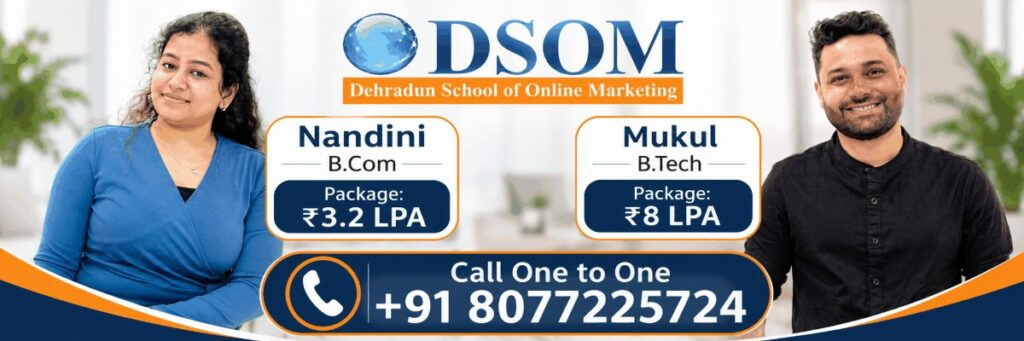
Mukul’s Story: From B.Tech to Digital Marketing
Mukul was a B.Tech graduate with average confidence.
After completing his engineering studies, he discovered digital marketing and became interested in exploring this career option.
When he joined DSOM, Dehradun, he was already working in a small government job and earning just ₹8,000 per month — but he wanted to achieve more.
He started learning SEO and social media marketing part-time while continuing his work.
Within six months, he:
- Started getting freelance projects.
- Earned more than some of his peers.
- Built a professional portfolio and reputation.
Today, Mukul works in a stable job, earning around ₹65,000 per month, while working remotely from home — something he once thought was difficult to achieve.
The lesson? The right skills, practical experience, and a positive mindset can create new opportunities.
You can connect with Mukul on LinkedIn to explore his digital marketing journey, achievements, and portfolio.
Still Unsure? Here Are 7 Powerful Reasons Digital Marketing Is a Great Option After B.Tech
1. Escape Typical B.Tech Career Struggles
Many B.Tech graduates face common career challenges:
- Limited job opportunities in their core engineering branch.
- Repetitive roles that may not match their interests.
- Pressure to pursue technical jobs even when they do not enjoy them.
Digital Marketing After B.Tech can help you explore a different career direction.
It opens doors to practical, skill-based roles such as:
- Digital Marketing Executive
- SEO Analyst
- PPC Specialist
- Social Media Manager
You are no longer limited to opportunities related only to your engineering branch.
2. Zero Coding Pressure
Not everyone enjoys coding. However, many engineering graduates feel that choosing a technical degree means they must build their entire career around programming.
Digital marketing offers a different approach. Instead of focusing mainly on syntax and debugging, you work with strategy, creativity, and data analysis.
Your logical thinking remains valuable. You can use it to:
- Analyse marketing campaigns.
- Understand and interpret performance data.
- Make smart, results-driven decisions.
If coding does not interest you, digital marketing can offer a more suitable combination of creativity and analytical work.
3. Use Digital Skills for Your Own Business
Digital marketing is not limited to finding a job. You can also use these valuable skills to promote your own business or develop a side hustle.
For example:
- Civil and Mechanical Engineers: Promote construction projects, designs, products, or services.
- Electronics and Electrical Engineers: Market technology solutions, gadgets, or technical services.
- CSE and IT Graduates: Build an online presence for apps, software products, or consulting services.
You can learn how to:
- Run targeted online advertisements.
- Build a strong brand identity.
- Track campaign performance.
- Improve website visibility and generate leads.
These skills can help engineering graduates turn business ideas into practical opportunities.
4. Higher Earning Potential
Starting salaries in some engineering fields can be limited, particularly when graduates have little practical experience.
Digital marketing offers opportunities for financial growth as you develop specialised skills and gain experience.
Indicative salary ranges mentioned in this article include:
- Freshers: ₹3.5–6 LPA
- Experienced Professionals: ₹10–20 LPA+
Your earning potential can depend on your experience, expertise, location, industry, and ability to deliver results. Specialised skills and international freelance projects may also create additional opportunities.
5. Practical, Job-Ready Skills
Unlike careers that may involve extensive theoretical learning, digital marketing focuses heavily on practical implementation.
You can develop valuable skills in:
- Search Engine Optimization (SEO)
- Social Media Marketing
- Google Ads and PPC
- Content Strategy
- Email Marketing
- Affiliate Marketing
- Analytics and Reporting
Learning these tools and techniques can help you understand how businesses attract customers and generate measurable results.
6. Unmatched Career Flexibility
One of the most attractive advantages of digital marketing is its flexibility.
Depending on your skills and experience, you can:
- Explore work-from-home opportunities.
- Take freelance or international projects.
- Specialise in SEO, PPC, analytics, or content marketing.
- Start your own agency or consulting service.
Your career, your pace, and your choices.
For students considering Digital Marketing After B.Tech, this flexibility can make the field an interesting alternative to traditional career paths.
7. A Clear Career Path and Stronger Confidence After B.Tech
After completing engineering, some graduates feel confused about their next career move.
Digital marketing can provide a structured starting point for students who want to develop new professional skills.
The field can be:
- Beginner-friendly with the right training.
- Easier to explore without an advanced coding background.
- Practical and focused on real-world tasks.
- Growth-oriented for people willing to learn consistently.
As you gain experience, complete projects, and build a portfolio, you can develop greater confidence and a stronger professional profile.
But Wait — Digital Marketing Isn’t Perfect: Here’s the Flip Side
Every career has advantages and challenges. Before choosing digital marketing, it is important to understand the possible drawbacks too.
1. No Instant Results
Digital marketing does not guarantee overnight success.
It takes time to:
- Develop practical skills.
- Understand different platforms.
- See meaningful campaign results.
- Build expertise in a particular area.
You need patience, consistency, and a willingness to learn from mistakes.
2. A Highly Competitive Field
Since digital marketing has a relatively accessible entry path, competition can be high.
To stand out, you need to:
- Build a strong portfolio.
- Practise with relevant tools.
- Work on real or sample projects.
- Stay updated with industry trends.
Simply completing a course may not be enough. Your practical knowledge and ability to deliver results also matter.
3. Constant Learning Is Required
Digital marketing changes quickly.
Search engine algorithms, advertising platforms, social media features, and marketing strategies are regularly updated.
You must be prepared to:
- Adapt to changes.
- Upgrade your skills.
- Explore new tools.
- Learn continuously.
If you prefer a career where everything remains the same, these frequent changes may feel overwhelming.
4. Not a Traditional, Prestigious Engineering Career
Some students feel pressure when choosing a career outside their engineering branch.
This can happen because:
- Family members expect them to pursue a core engineering job.
- Friends may choose traditional technical careers.
- Digital marketing may appear non-technical to people who do not understand the industry.
Choosing a different career path requires confidence and a clear understanding of your professional goals.
Despite these challenges, digital marketing can be a rewarding option for graduates who enjoy creativity, technology, business growth, and continuous learning.
Engineering Salary Reality (India)
Salary expectations are an important part of career planning. However, starting salaries can vary significantly depending on location, company, skills, college, and experience.
The following figures are indicative ranges from the original article, not guaranteed salary offers.
| Engineering Branch | Typical Starting Salary | Common Challenges |
| Civil | ₹12k–₹22k/month | Field-based work and varying growth |
| Mechanical | ₹15k–₹25k/month | Long hours and physical work in some roles |
| Electrical/ECE | ₹15k–₹28k/month | Availability of core-sector opportunities |
| CS/IT | ₹20k–₹35k/month | Strong coding skills may be expected |
| Other branches | ₹12k–₹20k/month | Opportunities can vary by specialisation |
Now, let’s look at the indicative salary structure in digital marketing.
Digital Marketing Salary Structure (After B.Tech)
| Job Role | Salary Range |
| Digital Marketing Executive | ₹3–₹5 LPA |
| SEO Specialist | ₹4–₹7 LPA |
| PPC Expert | ₹6–₹12 LPA |
| Social Media Manager | ₹5–₹10 LPA |
| Digital Marketing Manager | ₹10–₹20 LPA |
These salary figures are indicative and may vary depending on expertise, company, experience, and location.
This is why Digital Marketing After B.Tech can be worth exploring. Developing valuable skills and gaining practical experience can help you work towards better career opportunities and professional growth.
Digital Marketing as a Side Hustle
You do not necessarily have to choose digital marketing as a full-time career from the beginning.
Once you understand the basics, you can explore small freelance projects such as:
- Social media management.
- SEO-related tasks.
- Running simple advertising campaigns.
- Freelancing for local businesses.
- Content writing.
These projects can help you gain practical experience, build a portfolio, and understand how businesses work online.
Some learners may earn ₹20,000 to ₹60,000 per month through side projects, depending on their skills, clients, workload, and experience. However, this is not a guaranteed income.
Digital marketing can offer flexible work possibilities, but building a reliable side income requires time, effort, and consistent client work.
Conclusion: Your B.Tech Doesn’t Define Your Future — Your Skills Do
If you feel stressed, confused, jobless, or pressured after completing B.Tech, remember that your engineering degree does not have to define your entire career.
Digital Marketing After B.Tech can be an opportunity to explore a new direction, develop valuable skills, and build a future-ready professional profile.
You don’t need to be an expert in coding.
You don’t need extraordinary talent.
You need curiosity, consistency, and the willingness to learn.
And that’s what students can work towards at DSOM (Dehradun School of Online Marketing).
Just like Mukul, you can explore new opportunities by developing practical skills and gaining real-world experience.
Your engineering degree is not wasted. It has helped you develop analytical thinking, problem-solving abilities, and a technical foundation.
Now, you can build on that foundation with digital marketing skills.
Frequently Asked Questions (FAQs) About Digital Marketing After B.Tech
1. Is Digital Marketing a Good Career Option After B.Tech?
Yes, Digital Marketing After B.Tech offers career opportunities in SEO, Google Ads, social media marketing, and performance marketing.
2. Can I Learn Digital Marketing After B.Tech Without Coding?
Yes, advanced coding is not required. Creativity, analytical thinking, and basic technical knowledge are helpful.
3. What Is the Salary After Learning Digital Marketing?
Freshers may earn approximately ₹3–6 LPA, depending on their skills, experience, and company.
4. Which Skills Should B.Tech Students Learn?
Students should learn SEO, Google Ads, social media marketing, content marketing, and Google Analytics.
5. Where Can I Learn Digital Marketing After B.Tech?
You can explore practical training at DSOM, with industry-relevant tools, live projects, and practical learning.