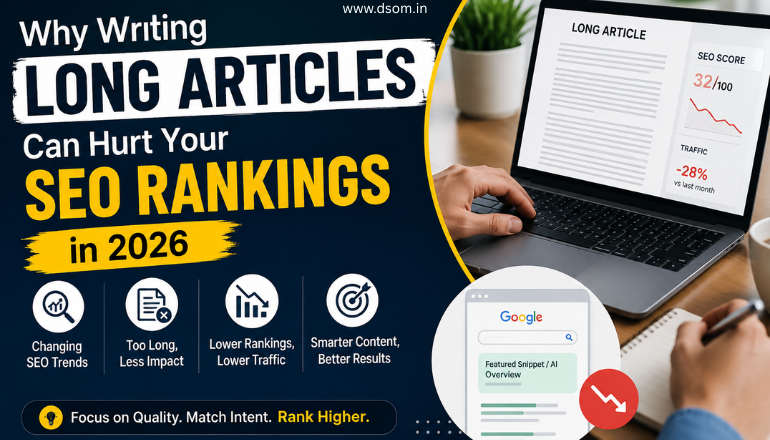
Why Writing Long Articles Can Hurt Your SEO Rankings in 2026
For years, publishing more content was the go-to strategy for growing SEO. But in 2026, that same approach is silently damaging rankings, wasting budgets, and handing visibility to competitors. Here’s what changed, why it matters, and what to do instead.
You have a content calendar and you are publishing three articles a week. Now, your website has hundreds of pages. Still Google traffic is flat and rankings are slipping, Clicks are declining. Something is wrong, but nobody can point to exactly what.
If you are thinking that you should post more then STOP! Then the brutal truth is, writing long articles can hurt your seo, Yes you heard me right.
For over a decade, content volume was treated as one of the most reliable growth levers in SEO. The logic was simple, more pages meant more keywords, more keywords meant more rankings, more rankings meant more traffic. Your entire work was around this idea.
Content factories ran at full speed. And for a long time, it worked. But the conditions that made it work no longer exist. And sites still operating on that old model are paying a price they don’t fully understand yet so it is better to know that Long Articles Can Hurt your SEO .
What Changed in SEO in 2026?
SEO has evolved significantly in recent years. Google now uses advanced algorithms and AI systems to understand user intent and content quality.
Before jumping into the reasons, it’s important to understand how search engines now evaluate content.

Key Changes in SEO:
- Focus on user intent instead of just keywords
- Preference for helpful and concise content
- Importance of engagement signals like time on page
- Rise of AI-generated answers in search results
These changes mean that writing long articles alone is not enough anymore.
How Articles Were Ranked Before?
You know how previously you got ranked by Google. But have you ever wondered how and why it actually worked? Between roughly 2010 and 2020, the SEO landscape was very different, and content volume was a rational response to how search engines behaved.
Search engines at that time evaluated content mainly through keyword matching and topical coverage. If your page contained the right keywords and covered the topic well, it had a strong chance of ranking.
The web was also far less crowded, and most commercially relevant topics had limited high-quality competition. This meant a new article could easily find space and rank quickly.
However, this is exactly where many people misunderstand modern SEO. The same strategy of writing longer and longer articles to cover more keywords no longer works today. In fact, writing long articles without clear intent, structure, and value can hurt your SEO rankings. Instead of helping, it can dilute keyword focus, reduce user engagement, and make your content less effective in today’s search environment.
What made content volume so effective back then?
- Keyword matching was king — more pages targeting more keyword variations meant more chances to appear in search results.
- Low competition — most niches had fewer than a dozen strong pages on any given topic, giving new content room to rank fast.
- Freshness signals — sites that published frequently were seen as active and relevant, which boosted overall domain authority.
- Long-tail opportunity — there were thousands of underserved, low-competition queries that no one had written about yet, and covering them was genuinely profitable.
- Programmatic SEO worked — creating thousands of templated pages targeting keyword variations drove real, scalable traffic at low cost. Publishing more was not a lazy strategy. It was a smart response to the environment. The problem is the environment changed, and the strategy didn’t.
Why writing Long Articles Can Hurt your SEO Rankings Now?
Why writing Long Articles Can Hurt your SEO? Many websites still follow the old strategy of writing long content, but this can create multiple issues. Below are the major reasons why long articles can negatively affect your SEO.

1. Poor User Experience
Long content can often feel overwhelming, especially when users are looking for quick answers. Most users prefer content that is easy to scan and understand.
Common Problems with Long Articles:
- Too much unnecessary information
- Difficult to read and navigate
- Important points are hard to find
Result: Users leave the page quickly, increasing bounce rate and hurting SEO.
2. Low Content Relevance
When trying to increase word count, many writers add extra information that is not directly related to the topic. This reduces the overall quality of the content.
Issues Caused by Irrelevant Content:
- Content becomes unfocused
- User intent is not properly satisfied
- Readers lose interest
Result: Google ranks more relevant and focused content higher.
3. Keyword Dilution
In long articles, maintaining keyword focus becomes difficult. Instead of strengthening SEO, it weakens the content’s targeting.
What Happens in Long Content:
- Main keyword appears less strategically
- Multiple topics confuse search engines
- Content loses topical authority
Result: Lower rankings for target keywords.
4. AI Overviews Reduce Clicks
Search engines now provide direct answers using AI, reducing the need for users to click on articles.
Impact of AI on Long Content:
- Informational queries are answered instantly
- Long articles get fewer clicks
- Visibility decreases despite ranking
Result: Traffic drops even if your content is indexed.
5. Crawl Budget Issues
Every website has a limited crawl budget. Long and unnecessary content can waste this budget.
Problems with Crawl Budget:
- Search engines spend more time on low-value content
- Important pages may not be crawled frequently
- Indexing becomes inefficient
Result: Reduced overall SEO performance.
6. Weak Engagement Signals
User engagement plays a major role in SEO rankings. Long articles often fail to keep users engaged till the end.
Engagement Issues:
- Low scroll depth
- Short time on page
- Minimal interaction
Result: Search engines consider the content less useful.
7. Content Maintenance Challenges
Long articles require continuous updates to stay relevant. Without updates, they quickly become outdated.
Maintenance Problems:
- Difficult to update large content
- Outdated information reduces trust
- High effort required for optimization
Result: Rankings decline over time.
Long Articles vs Optimized Content (SEO Comparison)
Before choosing your content strategy, it’s important to understand how long articles compare with optimized content in modern SEO.

| Factor | Long Articles | Optimized Content |
|---|---|---|
| User Experience | Complex | Easy to read |
| SEO Performance | Unstable | Strong |
| Keyword Focus | Weak | Clear |
| Engagement | Low | High |
| Maintenance | Difficult | Easy |
| Ranking Stability | Low | High |
This comparison clearly shows that optimized content performs better than unnecessarily long articles.
Does Content Length Still Matter?
Content length still plays a role in SEO, but it is no longer the main ranking factor. The focus has shifted towards delivering value. And you should know that Long Articles Can Hurt Your SEO Rankings in 2026.
Before deciding content length, consider the following factors.
When Content Length Matters:
- Complex topics need detailed explanations
- Competitive keywords require in-depth coverage
- Informational guides need clarity and depth
The goal is not to write long articles but to write complete and useful content.
What Google Prefers in 2026
Google now prioritizes content that provides value and satisfies user intent so according to google writing Long Articles Can Hurt your SEO. Understanding these factors can help improve your rankings.
Key Ranking Factors:
- Content relevance and accuracy
- Clear answer to user queries
- High engagement and readability
- Strong E-E-A-T signals (Experience, Expertise, Authority, Trust)
- Proper content structure
These factors matter more than just content length.
Smart SEO Strategy Instead of Writing Long Articles
Instead of focusing on word count, modern SEO requires a smarter and more strategic approach. It i sbetter to know that Long Articles Can Hurt your SEO so Below are the most effective strategies you should follow to avoid these mistakes.
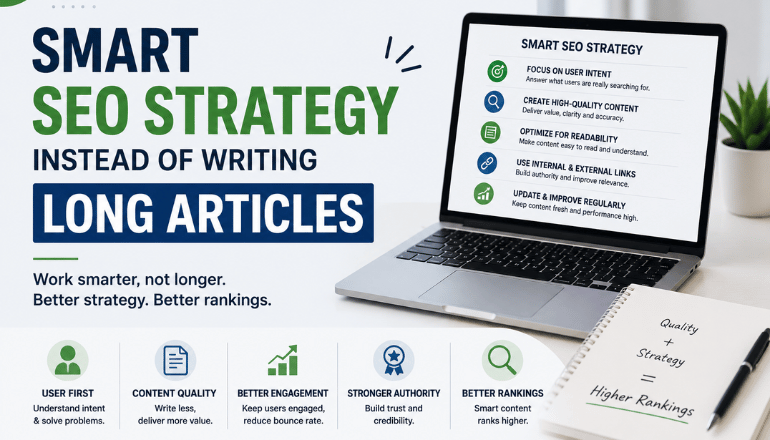
1. Focus on Quality Over Quantity
Quality content always performs better than long but weak content. Write only what adds value to the reader.
What to Do:
- Remove unnecessary information
- Keep content clear and focused
- Provide useful insights
2. Optimize Content Structure
A well-structured article improves both readability and SEO performance.
Use Proper Formatting:
- Headings (H1, H2, H3)
- Bullet points
- Short paragraphs
This makes content easy to scan and understand.
3. Match User Intent
Understanding what users are searching for is the most important part of SEO.
Ask Before Writing:
- What problem is the user solving?
- What answer do they expect?
Create content that directly addresses these needs.
4. Perform Content Audit
Regular content audits help identify weak pages and improve overall website performance.
Audit Checklist:
- Find low-performing pages
- Update outdated content
- Remove irrelevant pages
5. Update Existing Content
Updating old content is more effective than creating new content in many cases.
Update Strategy:
- Add new data and examples
- Improve readability
- Optimize keywords
6. Use Internal Linking
Internal links help search engines understand your website structure and improve rankings.
Benefits of Internal Linking:
- Boosts page authority
- Improves navigation
- Enhances SEO performance
7. Avoid Overwriting
Writing more does not always mean better content. Focus on clarity instead of length.
Best Practice:
- Keep content concise
- Avoid repetition
- Stay on topic
Best Content Length for SEO
Choosing the right content length depends on the type of content and user intent. Below is a general guideline to help you to know that writing Long Articles Can Hurt your SEO.
| Content Type | Ideal Length |
|---|---|
| Blog Post | 800–1200 words |
| Guide Article | 1200–1500 words |
| Product Page | 500–800 words |
| Informational Page | 700–1000 words |
Always prioritize value over word count.
Common SEO Mistakes to Avoid
Many websites fail in SEO because of common mistakes related to content length and strategy. Avoiding these mistakes can improve your performance.
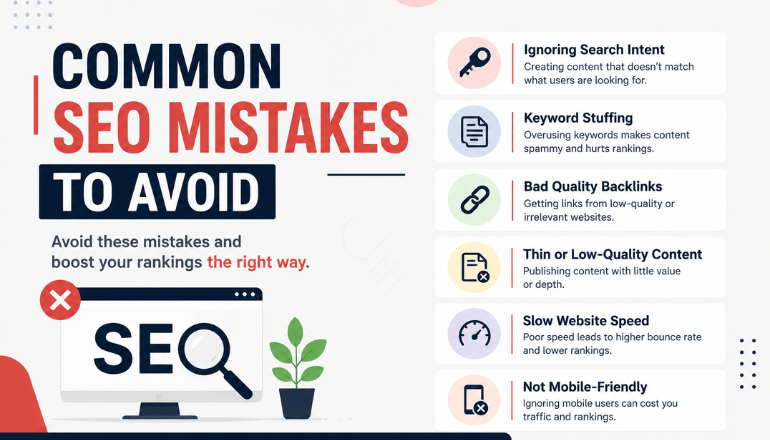
Mistakes to Avoid:
- Writing long articles without purpose
- Adding unnecessary content
- Ignoring user intent
- Not updating content regularly
- Poor formatting and structure
- Keyword stuffing
Key Takeaways
Understanding the core idea behind modern SEO and to know that Long Articles Can Hurt your SEO is essential for success. Below are the most important points to remember.
Important Points:
- Long articles do not guarantee better rankings
- Content quality matters more than length
- User experience is a key ranking factor
- Engagement signals influence SEO
- Smart content strategy is essential
Conclusion
In 2026, writing long articles can hurt your seo, so long article is no longer a guaranteed way to rank higher on Google. In fact, it can harm your SEO if not done correctly.
The focus should be on creating valuable, relevant, and user-focused content. When your content solves real problems and matches user intent, it performs better regardless of length.
If you want to build a strong career in content writing and learn modern SEO strategies, choosing the right institute matters. DSOM Dehardun offers practical training in content writing, SEO, and digital marketing based on real industry trends.
Instead of outdated techniques like writing long articles blindly, DSOM teaches how to create smart, user-focused, and ranking content. With hands-on projects and expert guidance, it helps students understand what actually works in 2026 SEO.
SEO success today is about quality, not quantity