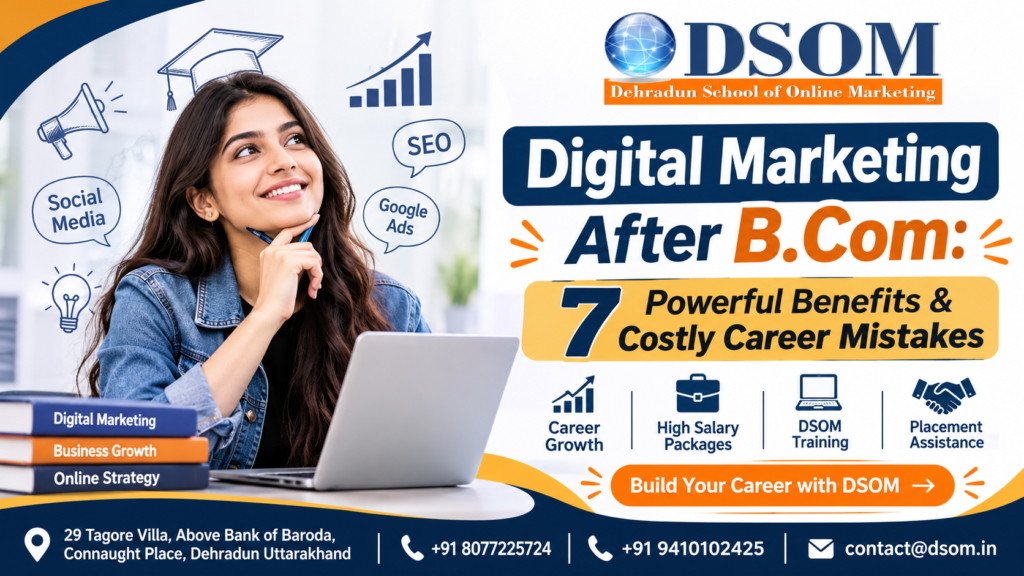
Introduction: Turn Your B.Com Degree into a Powerful Career Opportunity
Your B.Com degree is not the end of your career journey—it can be the beginning of something bigger! In today’s competitive job market, a traditional commerce degree combined with practical digital skills can open exciting opportunities in marketing, business growth, advertising, and analytics.
Imagine turning your knowledge of business, finance, and marketing into a career where you can work with brands, manage advertising campaigns, analyze customer behavior, and even explore international job opportunities.
That is the potential of Digital Marketing After B.Com.
Digital marketing is becoming an important part of how businesses attract customers and generate revenue. B.Com students already understand business fundamentals, making digital marketing a relevant career option for those who want to develop practical skills.
In this guide, we will explore the essential skills, career opportunities, salary packages, seven powerful benefits, costly mistakes, and how DSOM can help you prepare for a digital marketing career.
What Is Digital Marketing After B.Com?
Digital marketing refers to promoting products, services, and brands through online platforms such as search engines, websites, social media, email, and digital advertisements.
Businesses use digital marketing to reach their target audience, generate leads, increase sales, and measure campaign performance.
For commerce students, Digital Marketing After B.Com can be a practical career path because it combines business knowledge with online marketing strategies.
For example, a B.Com student understands basic business concepts such as revenue, expenses, customer demand, and profitability. Digital marketing helps apply these concepts to online campaigns and measurable business outcomes.
What Do You Learn in Digital Marketing?
A digital marketing course may cover:
- Search Engine Optimization (SEO)
- Social Media Marketing
- Google Ads and Meta Ads
- Content Marketing
- Email Marketing
- Website Analytics
- Performance Marketing
- Conversion Tracking
- Lead Generation
- Marketing Strategy
These skills can help students explore different career paths according to their interests.
Essential Skills for Digital Marketing After B.Com
Before choosing a digital marketing career, understand the skills that employers may expect from beginners.
1. Communication Skills
Digital marketers communicate with clients, team members, and customers. Writing clear captions, campaign briefs, emails, and reports is important.
2. Analytical Thinking
Commerce students often have an advantage in understanding numbers and business performance.
Digital marketers use analytics to understand traffic, conversions, advertising costs, and customer behavior.
3. Creativity and Content Planning
Marketing requires creative ideas that connect with the target audience.
Students can practice by creating social media posts, content calendars, advertising concepts, and campaign strategies.
4. Technical Understanding
You do not need to be a programmer to start digital marketing. However, understanding websites, tracking tools, analytics, and advertising platforms can be useful.
5. Business Understanding
A B.Com degree provides a foundation in business, accounting, and finance.
These concepts can help digital marketers understand campaign budgets, customer acquisition costs, profitability, and business goals.
Digital Marketing After B.Com becomes more valuable when students combine these business fundamentals with practical marketing skills.
7 Powerful Benefits of Digital Marketing After B.Com
1. Explore Multiple Career Opportunities
Digital marketing offers different career paths based on your skills and interests.
You can explore SEO, paid advertising, social media, content marketing, analytics, and email marketing.
Digital Marketing After B.Com can help students move beyond traditional commerce-related career options and explore marketing-focused roles.
2. Combine Commerce Knowledge with Practical Skills
B.Com students study business, accounting, economics, and finance.
Digital marketing allows them to apply this knowledge to real business activities, such as campaign budgeting, sales growth, and customer acquisition.
This combination can be useful when working with businesses that want measurable marketing results.
3. Develop Industry-Relevant Skills
Digital marketing platforms and tools are used by businesses across different industries.
Learning SEO, Google Ads, Meta Ads, analytics, and content marketing can help students develop skills relevant to entry-level marketing roles.
4. Explore Freelancing Opportunities
Digital marketing skills can be applied to freelance projects such as:
- SEO audits
- Social media management
- Content planning
- Website optimization
- Advertising campaign support
Freelancing income depends on the quality of work, client requirements, experience, and ability to deliver results. It is not guaranteed.
5. Understand Business Growth
Digital marketing is not only about posting content online.
It involves understanding customers, identifying opportunities, generating leads, improving conversion rates, and measuring business performance.
For B.Com graduates, these skills can create a useful connection between commerce education and business growth.
6. Explore International Career Opportunities
Digital marketing skills are used by businesses worldwide.
Professionals with relevant experience may explore opportunities in international markets, including the UAE, depending on employer requirements, work authorization, and market conditions.
Digital Marketing After B.Com can help students prepare for such opportunities by developing practical skills and a strong portfolio.
7. Build a Career Based on Continuous Learning
Digital marketing changes as platforms, algorithms, and consumer behavior evolve.
Professionals who continue learning can explore new specializations and improve their career opportunities.
This makes digital marketing a field where practical experience and updated skills can be important throughout your career.
Costly Career Mistakes to Avoid After B.Com
Choosing a career without understanding its requirements can lead to wasted time and money.
1. Choosing a Course Without Checking Practical Training
A course that focuses only on theory may not provide enough preparation for practical work.
Before enrolling, check whether the course includes assignments, projects, campaign planning, and tool-based learning.
2. Ignoring Digital Marketing Tools
Knowing the definitions of SEO or advertising is not enough.
Students should practice with relevant tools and understand how they support marketing decisions.
3. Expecting a High Salary Immediately
Digital marketing salaries depend on experience, specialization, skills, location, and employer requirements.
A beginner should focus on building practical skills rather than expecting a high package immediately after completing a course.
4. Avoiding Projects and Portfolio Development
A portfolio can help demonstrate your knowledge during interviews.
Create sample campaigns, keyword research reports, content calendars, and analytics projects.
5. Ignoring Analytics
Marketing results should be evaluated using measurable indicators.
Understanding impressions, clicks, conversions, cost per lead, and return on advertising spend can help you make better decisions.
6. Learning Too Many Tools Without Understanding Them
Listing multiple tools on your resume does not prove practical ability.
Choose relevant tools and learn how to use them through projects.
7. Waiting Too Long to Start
Students sometimes wait until graduation to explore career opportunities.
Start learning and practicing while completing your B.Com degree. Early preparation can help you build a portfolio and understand which specialization suits you.
Essential Digital Marketing Tools for B.Com Students
| Digital Marketing Tool | Purpose |
| Google Trends | Explore search interest and trends |
| Google Keyword Planner | Research keyword ideas |
| Google Search Console | Understand website search performance |
| Google Analytics 4 | Analyze website activity and user behavior |
| Google Ads | Learn paid search advertising |
| Meta Ads Manager | Explore Facebook and Instagram advertising |
| Canva | Create marketing graphics |
| Google Sheets | Organize campaign data and reports |
| Google Tag Manager | Manage website tracking tags |
The right tools can help students develop practical skills and create portfolio projects
Students can explore these official tools and learning resources:
- Google Trends
- Google Keyword Planner
- Google Search Console
- Google Analytics
- Google Skillshop
- Meta for Business
- Google Tag Manager
- Canva
These tools can support practical learning and help students understand how digital marketing campaigns are planned, implemented, and evaluated.
Digital Marketing Salary Packages After B.Com
One of the most common questions students ask is: How much can I earn after learning digital marketing?
The salary depends on the job role, experience, company, city, specialization, and practical knowledge.
The following table provides indicative salary ranges in India. These figures are approximate, not guaranteed offers.
| Job Role | Entry-Level Salary | Experienced Salary |
| Digital Marketing Executive | ₹2.5–4 LPA | ₹4–7 LPA |
| SEO Executive | ₹2–4 LPA | ₹4–8 LPA |
| Social Media Executive | ₹2–3.5 LPA | ₹4–7 LPA |
| Performance Marketing Executive | ₹3–5 LPA | ₹6–12 LPA |
| Digital Marketing Analyst | ₹3–5 LPA | ₹6–10 LPA |
| PPC Executive | ₹2.5–4.5 LPA | ₹5–9 LPA |
LPA means lakhs per annum. Actual salary packages vary by employer and candidate profile.
Digital Marketing After B.Com can provide opportunities to grow into specialized roles as you gain practical experience and develop relevant skills.
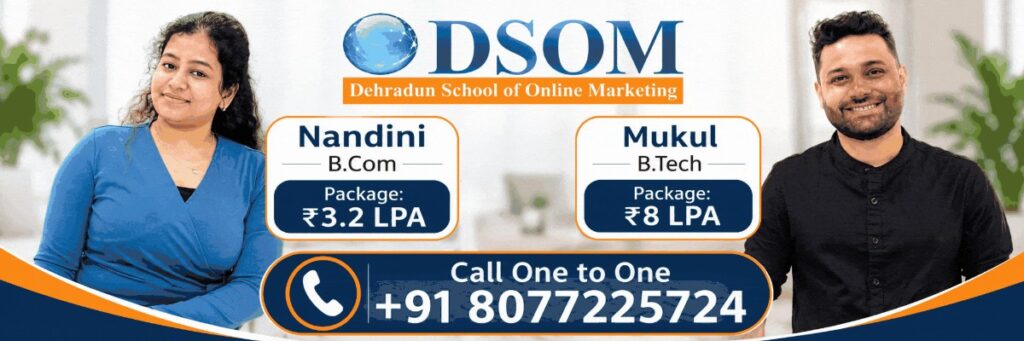
Nandini’s Career Journey: From DSOM Digital Marketing Training to a Dubai Job
Sometimes, a real career journey can inspire students more than a list of benefits.
Nandini is one of the learners whose journey highlights how practical digital marketing skills can support career opportunities.
After completing her Digital Marketing Course at Dehradun School of Online Marketing (DSOM), Nandini moved forward in her professional journey and secured a job in Dubai. Her starting package was ₹3.2 lakh. With experience and continued professional development, she is now earning more.
Her journey highlights an important lesson for students: learning a practical skill can help you explore opportunities beyond your traditional academic background.
For B.Com students, this is an encouraging example of how commerce knowledge combined with digital marketing skills can create new career possibilities.
Digital Marketing After B.Com is not only about learning tools. It is about developing the ability to apply those tools, understand business needs, and prepare for professional opportunities.
What Does the Latest News Say About Skills and Degrees?
According to a LinkedIn News India article published on 4 September 2025, titled “Degree or skills — what matters more?”, skills-first hiring could expand India’s talent pool by 11.4 times. The report also highlighted that 60% of Indian professionals believe a university degree is necessary for a successful career.
This finding shows that degrees still matter, but practical skills, adaptability, and continuous learning can help professionals stand out in a competitive job market.
For students exploring Digital Marketing After B.Com, this is an important takeaway. Your B.Com degree provides business knowledge, while digital marketing skills, practical projects, and internship experience can help demonstrate your ability to apply that knowledge in real-world situations.
Read the full report: LinkedIn News – Degree or Skills, What Matters More?
Why Choose DSOM for Digital Marketing After B.Com?
Dehradun School of Online Marketing (DSOM) offers digital marketing training for students and aspiring professionals who want to develop practical skills.
For B.Com graduates interested in digital marketing, structured training can help connect business knowledge with industry-relevant marketing practices.
Practical Training Approach
DSOM focuses on practical learning and skill development.
Students can explore digital marketing concepts and apply them through projects and assignments.
Industry-Relevant Tools
Digital marketing requires familiarity with tools used for SEO, advertising, analytics, and content creation.
Learning these tools can help students understand how marketing activities are planned and evaluated.
Internship Opportunities
Internship experience can help students understand workplace expectations and gain practical exposure.
DSOM provides internship-related opportunities as part of its training offerings. Students should confirm the current internship structure and eligibility directly with the institute.
Placement Assistance
DSOM offers placement assistance to support students in preparing for job opportunities.
Placement assistance may include career guidance and support during the job-search process. Final selection depends on employer requirements, interview performance, and individual skills.
Career-Focused Learning
DSOM emphasizes practical learning, relevant digital marketing skills, and career preparation.
Students can explore the official DSOM website for current course details and admission information.
DSOM Digital Marketing Course Fees
The approximate DSOM digital marketing course fees vary according to the course duration and program structure.
| Course Duration | Approximate Fees |
| 4-Month Course | ₹30,000–₹35,000 |
| 6-Month Course | ₹35,000–₹40,000 |
| 1-Year Diploma | ₹75,000–₹1,20,000 |
These fees are approximate and may change depending on the program, offers, and admission period. Confirm the latest fees and course inclusions directly with DSOM before enrollment.
Conclusion: Build a Powerful Career with Digital Marketing After B.Com With DSOM
Your B.Com degree provides a foundation in business, accounting, and finance. Digital marketing can help you apply that knowledge through practical projects, advertising, analytics, and customer-focused strategies.
Start by learning essential tools, creating a portfolio, and exploring a specialization that matches your interests.
Digital Marketing After B.Com can become a valuable career option when you combine your commerce knowledge with practical skills, continuous learning, and professional experience.
If you want to develop industry-relevant digital marketing skills, explore DSOM’s training programs, practical learning opportunities, internship options, and placement assistance.
Your next career opportunity can begin with the skills you choose to learn today.
Frequently Asked Questions
1. Is Digital Marketing After B.Com a good career option?
Yes. It can be a suitable option for B.Com graduates interested in marketing, business growth, advertising, and analytics.
2. What is the salary after Digital Marketing After B.Com?
Entry-level salaries may range from approximately ₹2.5–5 LPA, depending on the role, location, skills, and employer.
3. Can B.Com students learn digital marketing without technical knowledge?
Yes. Beginners can start with SEO, social media marketing, content marketing, and advertising fundamentals. Basic technical understanding can be developed through practice.
4. Which digital marketing tools should B.Com students learn?
Google Analytics, Google Search Console, Google Ads, Meta Ads Manager, Google Keyword Planner, Canva, and Google Sheets are useful tools to explore.
5. Does DSOM provide internship and placement assistance?
DSOM offers internship-related opportunities and placement assistance. Students should confirm current program details and placement terms directly with the institute.