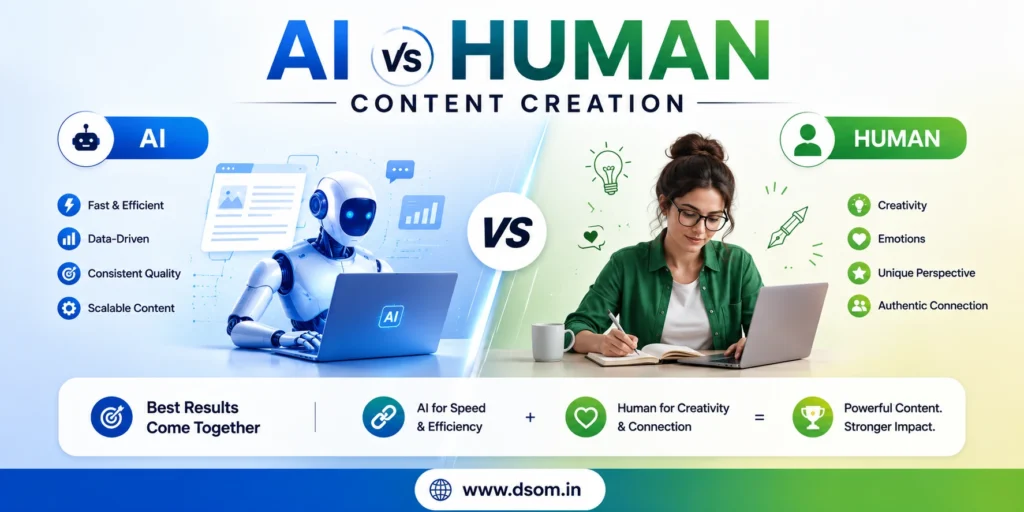
The debate around AI vs human content creation has never been louder — or more consequential. Every marketing team, content manager, and solo creator is wrestling with the same question: should I be using AI writing tools to speed up production, or am I risking my brand’s voice, my SEO rankings, and my audience’s trust by doing so?
The honest answer is more nuanced than either camp wants to admit. AI vs human content creation is not a binary choice where one side wins entirely. It is a spectrum, and where your content sits on that spectrum should be driven by strategy, not hype or fear.
Getting this wrong in either direction is costly — over-relying on AI produces content that underperforms long-term, while refusing to use AI at all leaves your competitors producing more content faster at lower cost.
This guide breaks down AI vs human content creation across every dimension that matters — quality, SEO performance, cost, speed, creativity, and long-term brand impact — so you can make an informed decision about how to use both in 2026.
What Has Changed in AI vs Human Content Creation
A few years ago, AI-generated content was easy to identify. It was generic, structurally awkward, and often factually unreliable. That is no longer true across the board. Today’s AI writing tools — including GPT-4o, Claude, and Gemini — produce fluent, well-structured text that can be difficult to distinguish from human writing at the surface level.
But surface-level fluency is not the same as genuine depth, original insight, or authentic voice. And that distinction is precisely what the AI vs human content creation debate in 2026 is really about — not whether AI can write, but whether what it writes genuinely serves your audience better than a skilled human could.
| Factor Changed | Old AI (2021–2023) | Current AI (2025–2026) |
|---|---|---|
| Text Fluency | Often awkward, detectable | Highly fluent and natural-sounding |
| Factual Accuracy | Frequent hallucinations | Improved, but still requires human verification |
| Original Thought | Rare | Still largely absent — synthesis not creation |
| Tone Customization | Limited | Strong with detailed prompting |
| SEO Optimization | Weak | Can be good with proper prompting |
| Brand Voice | Poor | Possible to replicate with extensive training |
AI Content Creation: The Real Strengths
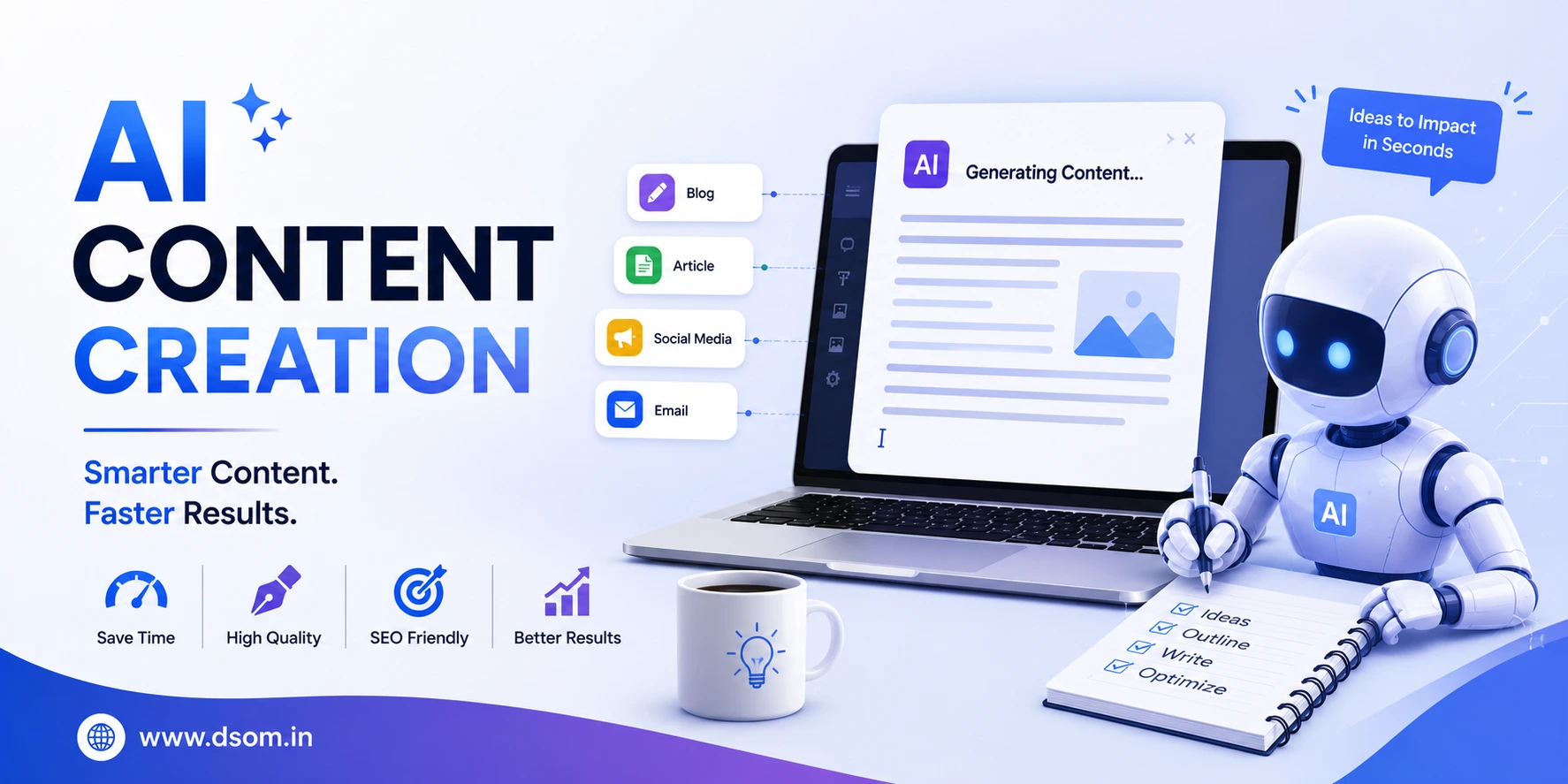
Understanding where AI content creation tools genuinely excel helps you deploy them strategically rather than reactively. These are the areas where, in any honest assessment of AI vs human content creation, AI wins clearly.
- Speed and Scale This is where AI vs human content creation has the most decisive gap. An AI writing tool can produce a 1,000-word first draft in under two minutes. A skilled human writer typically takes 2–4 hours to produce the same.
For teams that need to produce high volumes of content — product descriptions, FAQ pages, social media captions, or location-based landing pages — AI content creation is a genuine operational advantage. - Cost Efficiency AI content creation tools are significantly cheaper per word than professional human writers. For routine, templated content with low creative requirements, the cost savings are substantial and often impossible to ignore from a business perspective.
- Consistency at Scale When you need to produce content that follows a consistent structure — job listings, product specs, category page descriptions — AI content creation delivers predictable results without the variability that comes from using multiple human writers with different styles.

- First Draft Acceleration Even teams committed to high-quality human-written content often use AI as a starting point. Generating a rough structure, a list of subheadings, or an opening paragraph with AI — then having a human writer develop and refine it — is a legitimate hybrid workflow that genuinely combines the speed of AI with the depth of human expertise.
Human Content Creation: Where It Cannot Be Replaced
For all the advances in AI writing tools, there are categories of content where the AI vs human content creation comparison is not remotely close — and where deploying AI is a genuine mistake.
- Original Reporting and Research AI cannot interview sources, attend events, or break news. Any content that requires first-hand reporting, original primary research, or verified expert quotes is firmly in human territory. AI synthesizes existing information — it cannot create genuinely new knowledge.
- Complex Opinion and Analysis Strong opinion pieces, nuanced cultural commentary, and industry analysis that draws on lived professional experience require a human perspective that AI tools cannot replicate authentically. When readers detect that a point of view lacks genuine conviction or professional grounding, engagement drops — and so does trust.
- Emotional Storytelling Compelling brand stories, deeply personal narratives, and content designed to create an emotional response rely on a kind of human understanding that AI consistently falls short on. AI content quality in emotionally-driven writing is technically competent but often rings hollow.
- Highly Sensitive Topics Medical advice, mental health content, legal guidance, and financial recommendations need human expertise, professional accountability, and genuine empathy — none of which AI writing tools can provide responsibly.
AI vs Human Content Creation: SEO Performance Compared
Is AI content good for SEO? When it comes to AI vs human content creation, this is the question that determines most marketing budgets — and the answer is more layered than most people expect.
Google has stated it does not penalize AI-generated content per se — it penalizes low-quality, unhelpful content regardless of how it was produced. That means high-quality AI content can rank, and low-quality human content can fail. The mechanism of production is not what matters — the result is.
| SEO Factor | AI Content | Human Content |
|---|---|---|
| Keyword Optimization | Strong when prompted correctly | Strong when written by an SEO-aware writer |
| Content Depth | Average — synthesizes, doesn’t discover | High — can offer original insight |
| E-E-A-T Signals | Weak — no experience, no expertise trail | Strong — bylines, credentials, original research |
| Engagement Metrics | Often lower (thinner content) | Generally higher |
| Natural Link Earning | Rare — few share AI templated content | More common — original insight attracts links |
| Freshness | Fast to produce and update | Slower to update at scale |
The honest picture of human-written content SEO vs AI: human content tends to earn stronger long-term rankings because it builds E-E-A-T authority, attracts natural backlinks, and generates better engagement signals. But AI content, when carefully edited and enriched with original insight, can perform very well — particularly for informational, lower-competition keywords.
AI vs Human Content Creation: Direct Comparison
| Dimension | AI Content Creation | Human Content Creation |
|---|---|---|
| Speed | Minutes per article | Hours per article |
| Cost per Word | Very low | Medium to high |
| Originality | Synthesis of existing material | Can generate genuinely new ideas |
| Voice Consistency | Consistent with good prompting | Variable across writers without style guides |
| Factual Reliability | Requires verification | Requires fact-checking too, but more self-aware |
| Emotional Depth | Surface-level | Genuine when writer is skilled |
| SEO Ceiling | Medium (without heavy editing) | High (with experienced SEO writer) |
| Brand Trust | Risk of generic feel | Builds long-term authority and trust |
| Best Content Types | Product pages, FAQs, templates, social captions | Analysis, thought leadership, storytelling, journalism |
The Hybrid Approach: What Actually Works in 2026
The most effective content teams in 2026 are not choosing between AI and human content creation — they are building hybrid workflows that capture the best of both sides of the AI vs human content creation equation.
AI handles:
- First draft generation for templated or informational content
- Social media caption variations and A/B test copy
- Keyword research assistance and topic clustering
- Basic content briefs and structure outlines
Humans handle:
- Editorial judgment and quality control
- Original insight, opinion, and expertise
- Interviewing, reporting, and sourcing
- Final voice, tone, and brand alignment
- Strategy, planning, and audience understanding
This division of labor is not about cutting corners — it is about deploying resources intelligently. A skilled human writer who uses AI writing tools to handle the scaffolding can produce more high-quality content than one who starts from scratch every time.
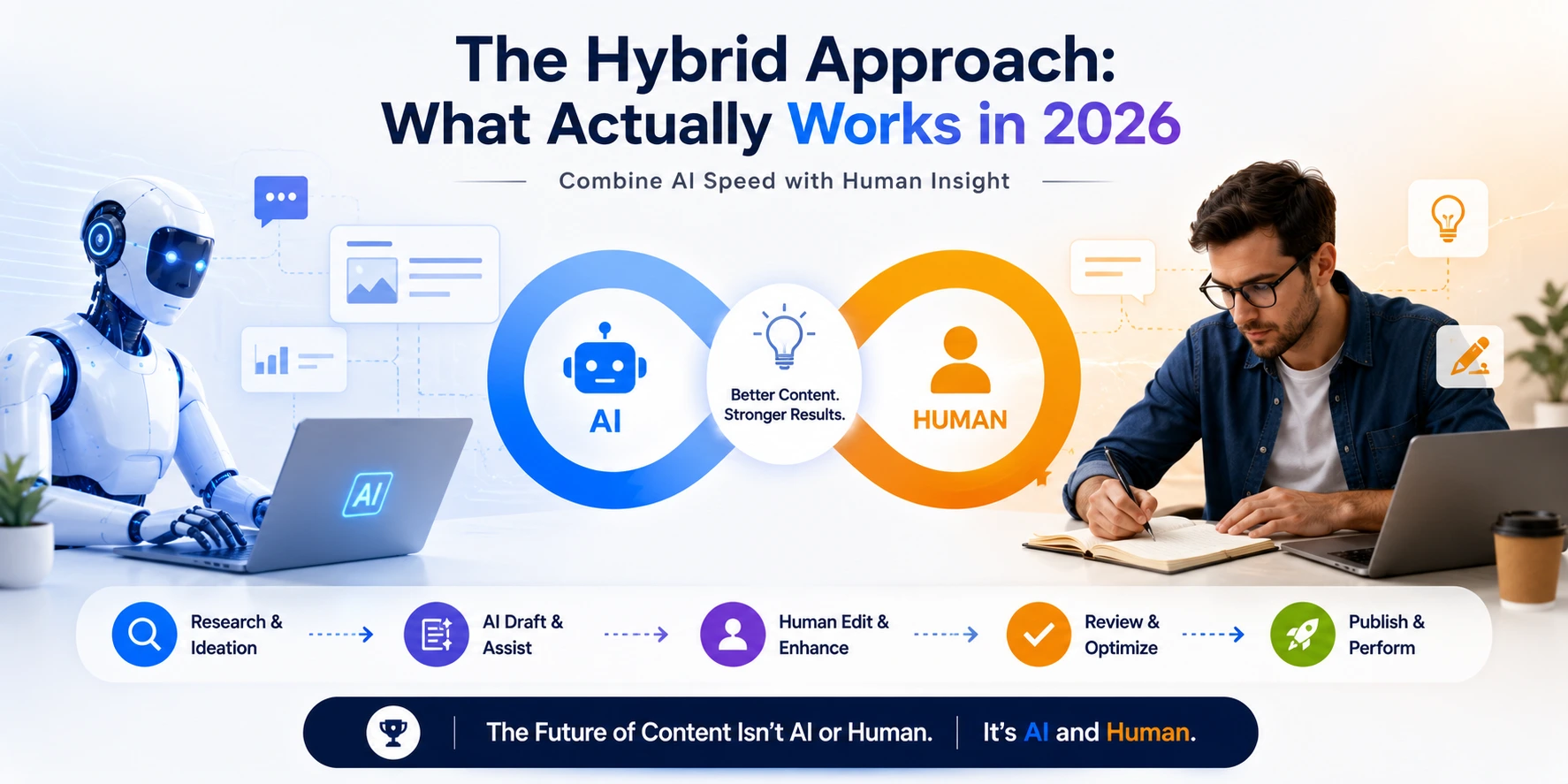
The result is AI content creation pros and cons in balance — speed and scale from AI, depth and authenticity from humans.
When to Choose AI, When to Choose Human
| Content Type | Recommended Approach |
|---|---|
| Product descriptions at scale | AI (with human review) |
| Long-form SEO blog posts | Hybrid — AI draft, human edit |
| Thought leadership articles | Human — original insight required |
| FAQ and help center content | AI (with subject matter expert review) |
| Brand storytelling and case studies | Human — emotion and authenticity critical |
| Social media captions | AI for volume, human for hero content |
| Medical, legal, or financial content | Human — accuracy and accountability essential |
| News and original reporting | Human — AI cannot break or verify news |
Final Thoughts
AI vs human content creation is not about choosing one over the other. AI tools can help create content faster, improve productivity, and streamline repetitive tasks, making them valuable for businesses and marketers looking to scale their content efforts.
To stay ahead in the evolving digital landscape, many professionals learn how to effectively combine AI tools with human creativity through training institutes like DSOM (Dehradun School of Online Marketing). Understanding when to use AI and when human expertise is needed can significantly improve content quality and marketing results.
The most effective content strategies use AI for speed and efficiency while relying on human insight for originality, expertise, and audience engagement. By balancing both approaches, businesses can create content that is not only efficient but also trustworthy, impactful, and valuable to their audience.