If you have ever searched something on Google and noticed the “Sponsored” results at the top of the page before the organic listings, you have already seen PPC advertising in action. It is one of the most widely used digital marketing channels in the world — and one of the most frequently misunderstood.
Whether you are a business owner considering your first ad campaign or someone completely new to paid digital marketing, this guide covers everything you need. By the end, you will understand exactly what is PPC, how PPC advertising works from click to conversion, and how to use it effectively for your business.
What is PPC?
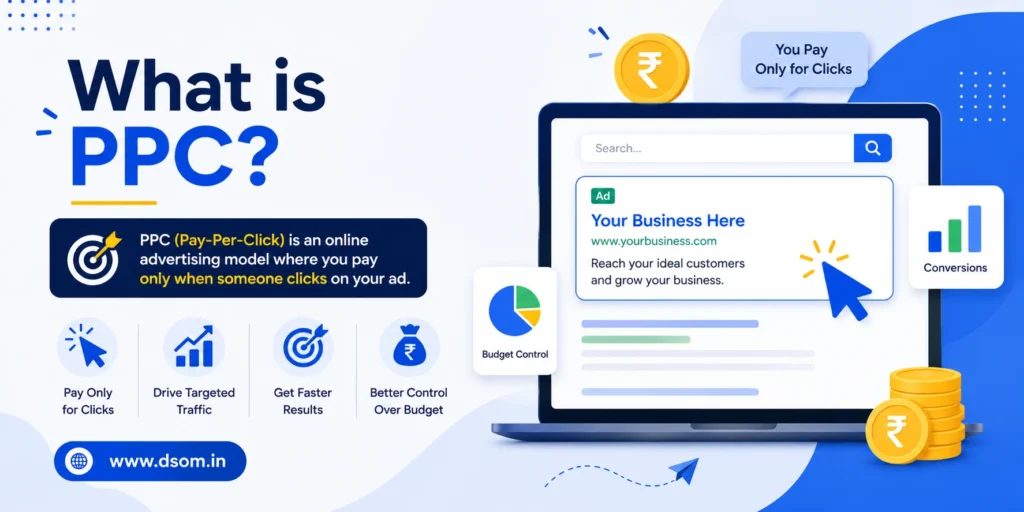
PPC stands for Pay-Per-Click — a model of digital advertising where you pay a fee each time someone clicks on your ad. Instead of earning traffic organically through SEO, you essentially buy visits to your website by placing ads on search engines, social media platforms, and display networks.
Key Definition: PPC (Pay-Per-Click) is a paid advertising model where you are charged only when a user clicks your ad — not when they simply see it.
The most common form of PPC advertising is search engine advertising — particularly through Google Ads, where businesses bid on keywords so their ads appear in search results when users search for those terms. But the channel also includes display ads, video ads, shopping ads, and social media advertising on platforms like Meta, LinkedIn, and TikTok.
The core principle is simple: you only pay when someone actually clicks your ad, not just when they see it. This makes pay per click advertising a highly accountable and measurable channel — every click has a known cost, and every conversion can be traced back to a specific ad, keyword, or campaign.
How Does PPC Advertising Work?
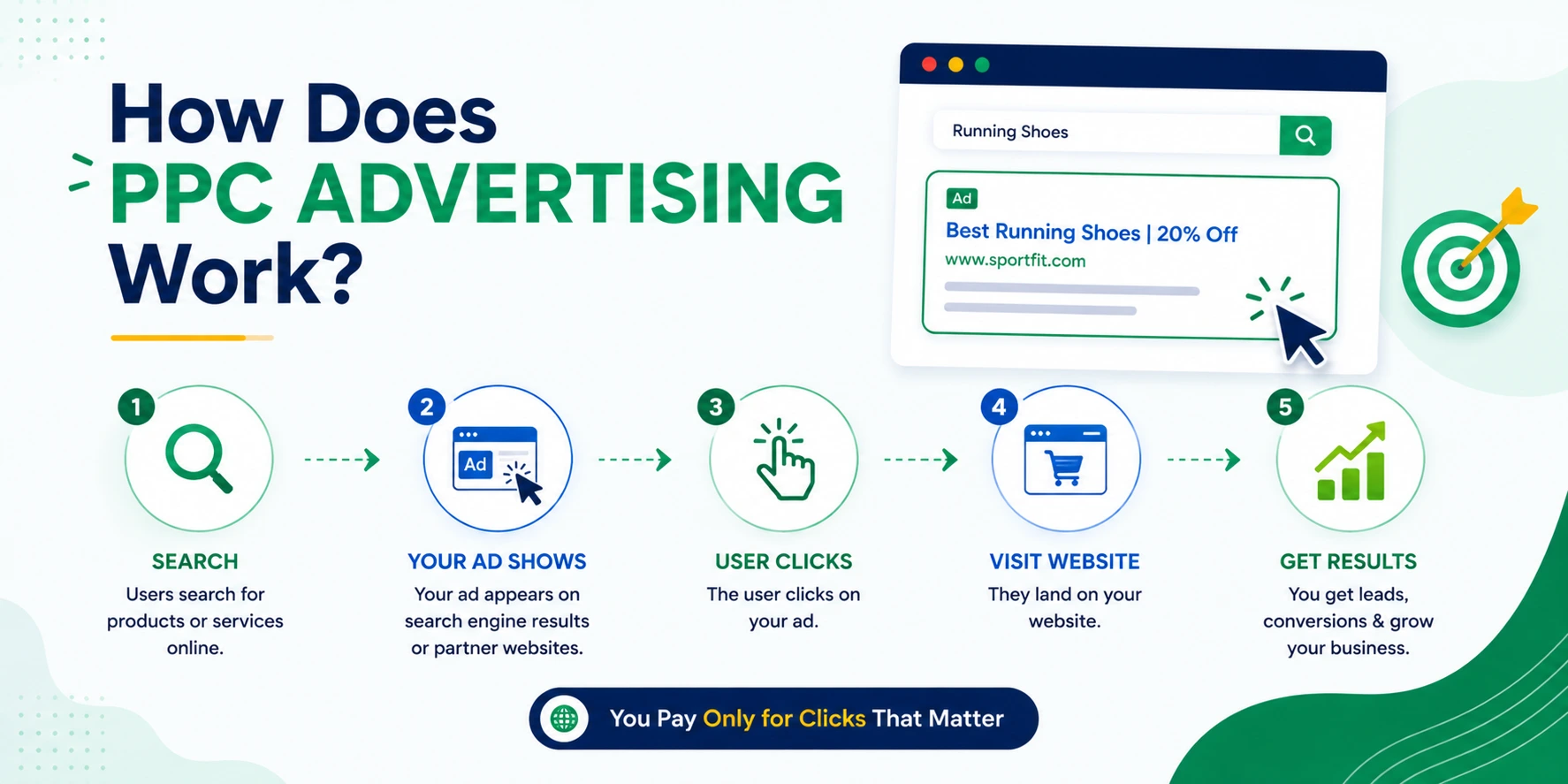
Understanding how PPC advertising works involves knowing three key components: the auction, the bid, and the ad rank.
The PPC Auction
Every time a user performs a Google search, an instantaneous auction takes place behind the scenes. Advertisers who have bid on keywords related to that search enter the auction. The winner’s ad appears — but winning the auction is not purely about who bids the most.
Ad Rank and Quality Score
Google determines which ads appear (and in what position) using a metric called Ad Rank, calculated from:
- Your maximum bid — the most you are willing to pay per click
- Quality Score — Google’s rating of your ad’s relevance, expected click-through rate, and landing page quality
- Expected impact — the influence of your ad extensions and additional formats
This means a well-optimized ad with a strong Quality Score can outrank a competitor who is bidding more money.
Critical Insight: Quality matters as much as budget in PPC advertising. A lower bid with a higher Quality Score regularly beats a higher bid with poor relevance — meaning smarter campaigns beat bigger spenders.
How Much Do You Pay?
In most PPC campaigns, you do not actually pay your maximum bid. You pay just enough to beat the Ad Rank of the advertiser below you — often significantly less than your maximum. This is called the actual CPC (cost per click), and it is typically lower than your stated bid, making PPC advertising more efficient than many newcomers expect.
Key Components of a PPC Campaign
Understanding how PPC advertising works also means understanding the building blocks of any campaign.
| Component | What It Is | Why It Matters |
|---|---|---|
| Keywords | The search terms you bid on | Determines when your ads show |
| Negative Keywords | Terms you exclude from triggering your ads | Prevents wasted budget on irrelevant clicks |
| Ad Copy | Headlines and descriptions of your ad | Determines whether users click |
| Landing Page | The page users arrive at after clicking | Determines whether clicks convert |
| Bid Strategy | How you set and manage your bids | Controls cost and volume |
| Quality Score | Google’s relevance rating (1–10) | Affects ad position and cost per click |
| Ad Extensions | Extra information added to ads | Improves CTR and ad visibility |
| Conversion Tracking | Measuring actions after a click | Tells you what is actually working |
Each of these components interacts with the others. A high-converting landing page improves Quality Score, which lowers your cost per click. Better ad copy improves CTR, which also improves Quality Score. In PPC advertising, everything is connected.
Types of PPC Ads
PPC advertising is not limited to the text ads you see in Google search results. The channel spans several formats across different platforms.
| PPC Ad Type | Where It Appears | Best For |
|---|---|---|
| Search Ads | Google / Bing search results | High-intent buyers actively searching |
| Display Ads | Websites, apps, YouTube | Brand awareness and retargeting |
| Shopping Ads | Google search results (product cards) | Ecommerce and physical products |
| Video Ads | YouTube, Google Display Network | Brand storytelling and awareness |
| Responsive Search Ads | Google search (auto-optimized) | Testing multiple headlines at scale |
| Social PPC Ads | Facebook, Instagram, LinkedIn, TikTok | Audience targeting by demographics/interests |
| App Ads | Google Play, App Store, Display Network | Driving app installs and in-app actions |
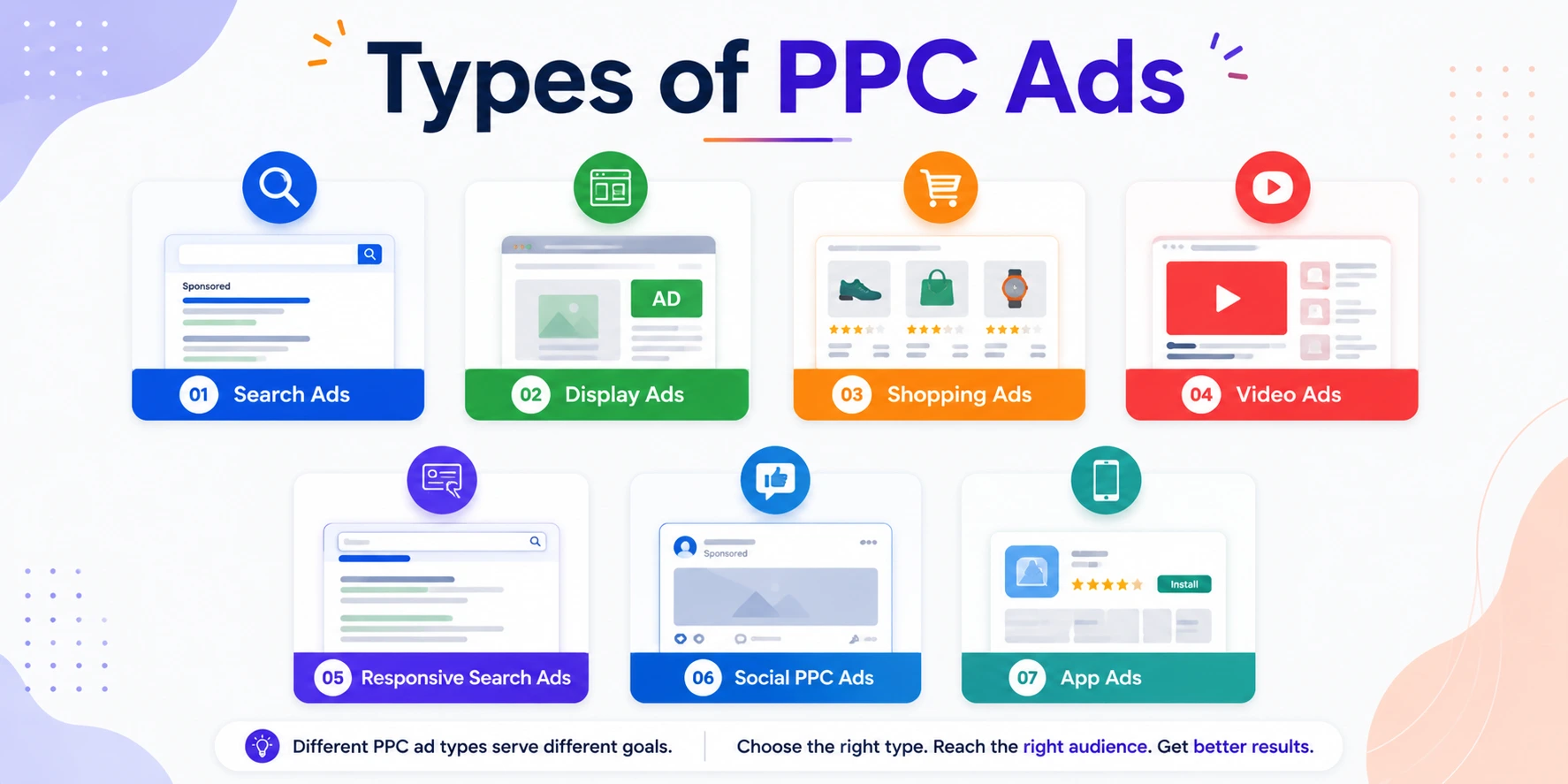
Google Ads PPC is the dominant platform and the starting point for most businesses, but social media PPC campaigns on Meta and LinkedIn can deliver strong results — especially for B2C and B2B brands respectively.
PPC vs SEO: What is the Difference?
One of the most common questions from those new to digital marketing is how PPC advertising compares to SEO (search engine optimization). Both aim to get your website visible on search engines, but they work very differently.
| PPC Advertising | SEO | |
|---|---|---|
| Speed | Immediate results — live within hours | Slow — months to see significant rankings |
| Cost | Pay per click — ongoing spend required | Primarily time investment; no per-click cost |
| Visibility | Guaranteed if budget is available | Earned through optimization over time |
| Sustainability | Stops when budget stops | Continues generating traffic after the work |
| Targeting Control | Very precise — keywords, location, device, time | Less granular targeting |
| Click Trust | Some users skip ads | Organic results often get more inherent trust |
PPC vs SEO is not a competition — the most effective digital strategies use both. PPC advertising delivers immediate traffic while your SEO builds long-term organic rankings. Together, they provide full search visibility across both paid and organic channels.
PPC Bidding Strategies Explained
A PPC bidding strategy determines how Google manages your bids to achieve your campaign goals. Choosing the right one is critical to getting results without overspending.
| Bidding Strategy | How It Works | Best For |
|---|---|---|
| Manual CPC | You set bids for each keyword manually | Full control, experienced advertisers |
| Enhanced CPC | Adjusts manual bids up or down based on conversion likelihood | Balance of control and automation |
| Target CPA | AI optimizes bids to hit a target cost per acquisition | Lead generation campaigns |
| Target ROAS | AI optimizes for a target return on ad spend | Ecommerce with revenue tracking |
| Maximize Clicks | Gets as many clicks as possible within budget | Traffic campaigns, new accounts |
| Maximize Conversions | Gets the most conversions within budget | Campaign with conversion data |
For PPC beginners, Maximize Conversions or Target CPA are often the most practical starting points once you have gathered at least 30–50 conversions. Before that, Maximize Clicks can help gather data while managing spend.
What Makes a PPC Campaign Successful?
The mechanics of PPC advertising are straightforward — the strategy is where most campaigns succeed or fail.
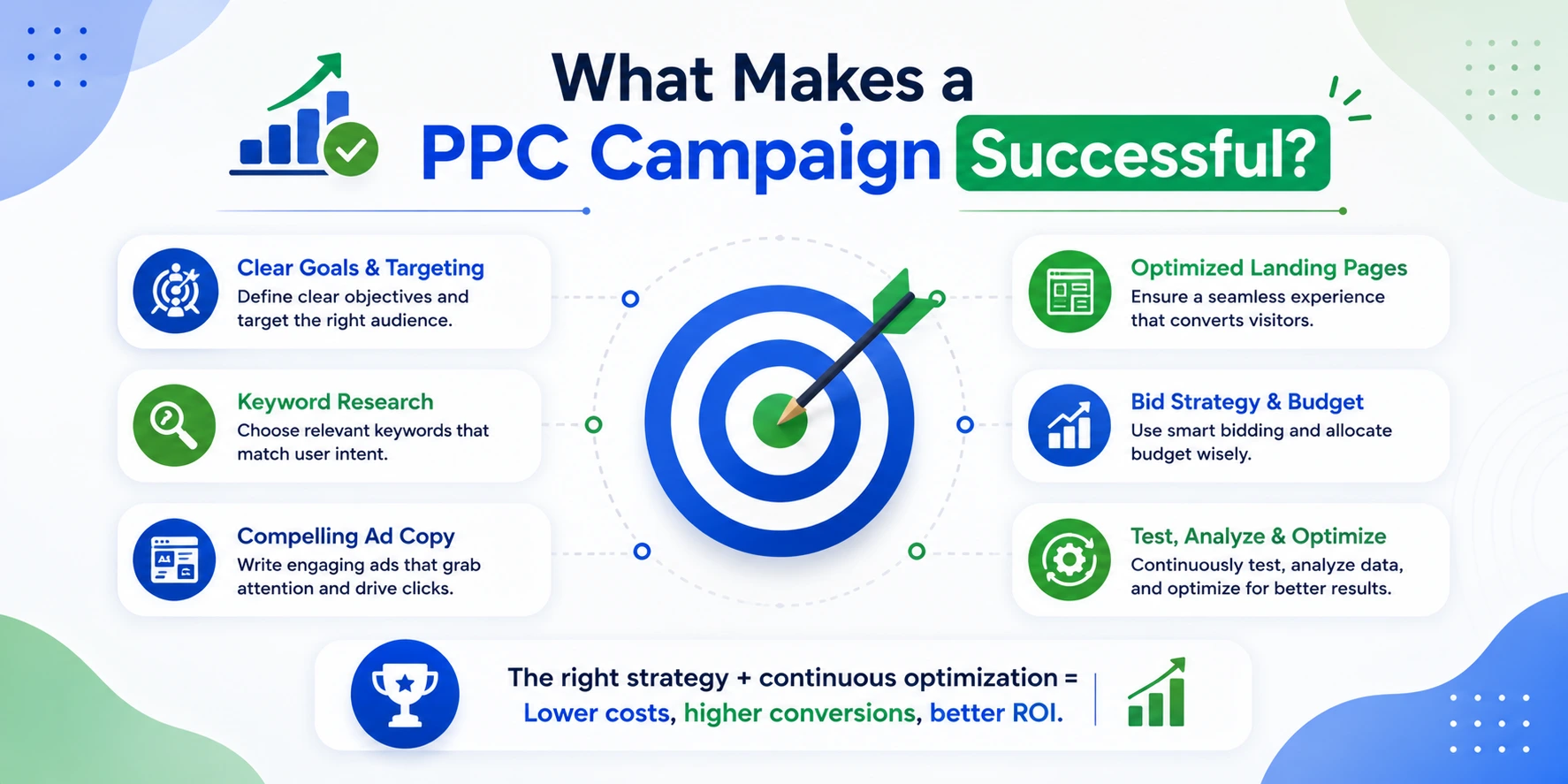
- Keyword Research: Target too broadly and you waste budget. Target too narrowly and you miss customers. Effective PPC keywords balance search volume, intent, and competition. Long-tail keywords often deliver the best return for businesses new to PPC advertising.
- Compelling Ad Copy: Your ad has a fraction of a second to earn a click. Strong headlines address the searcher’s specific need, include the target keyword, and communicate a clear benefit. The description expands on this with a direct call to action.
- High-Quality Landing Pages: A click is only the beginning. Your landing page needs to deliver on the ad’s promise — quickly and clearly. Mismatched messaging between ad and landing page hurts both conversions and Quality Score.
- Conversion Tracking: Setting up Google Ads conversion tracking before your campaign goes live is non-negotiable. It tells you which keywords, ads, and campaigns generate actual leads and sales — not just clicks.
- Negative Keywords: A negative keyword list prevents your ads from appearing for irrelevant searches, protecting your budget and improving your Quality Score and PPC ROI over time.
How Much Does PPC Advertising Cost?
One of the most asked questions about PPC advertising is what it costs. The honest answer is: it varies enormously.
| Industry | Average Cost Per Click | Reason |
|---|---|---|
| Legal | $10 – $50+ | High-value cases justify high bids |
| Finance & Insurance | $8 – $40 | High customer lifetime value |
| Healthcare | $5 – $20 | Regulated, competitive market |
| Ecommerce | $0.50 – $3 | High volume, lower margins |
| B2B Technology | $5 – $25 | Long sales cycles, high deal value |
| Local Services | $2 – $10 | Location-specific, moderate competition |
The key is not the cost per click itself — it is whether that cost makes sense relative to the value of a conversion. A $20 click that leads to a $2,000 service contract is exceptional ROI. A $2 click on a $30 product that converts at 2% barely breaks even.
Final Thoughts
PPC advertising is one of the most powerful tools in digital marketing — but only when approached with strategy, not just budget. Understanding what is PPC at its foundation, how the auction works, and how each component affects your results gives you the control to run campaigns that generate real returns.
If you’re looking to master PPC advertising through practical, industry-focused training, DSOM (Dehradun School of Online Marketing) offers hands-on learning in Google Ads, keyword research, campaign optimization, bidding strategies, and performance tracking.
Start with clear goals, choose the right keywords, write compelling ads, send traffic to optimized landing pages, and track everything from day one. That is what effective PPC advertising looks like in 2026 — campaigns that compound in value rather than quietly drain budgets.