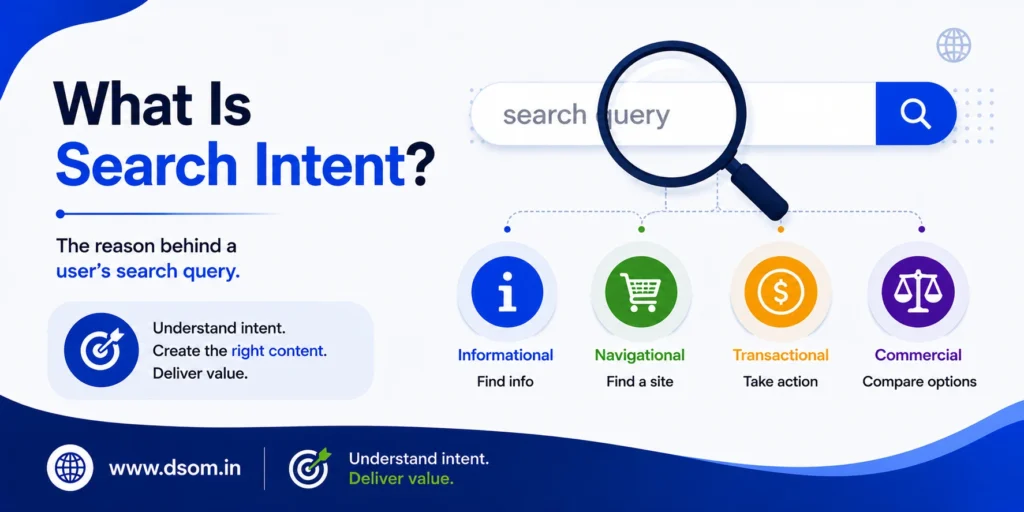
Every time someone types a query into Google, there is a reason behind it. They might want to learn something, find a specific website, compare two products, or buy something right now. That reason, the goal driving the search, is what SEO professionals call search intent. It’s one of those concepts that sounds straightforward but changes everything about how content strategy actually works in practice.
Think about how often you’ve seen websites rank for a keyword but completely miss the mark on what the searcher actually needed. That gap, between what a page offers and what a user actually wanted, is exactly what this concept is designed to fix.
If you’ve ever published a page that ranked for a keyword but failed to convert, or spent months chasing rankings that never came, a misaligned user intent is often the real reason. This guide explains what search intent is, why it matters more than ever in 2026, how the four main types work, and how to use this understanding to create content that actually serves both search engines and real people.
What Is Search Intent?
Search intent, also called user intent or query intent, is the primary goal a person has when they type something into a search engine. It answers a deceptively simple question: what does this person actually want to find?
The words in a query are just the surface layer. Two searches can share almost identical keywords but have entirely different goals. Someone searching for “running shoes” might want to browse options, read a review, or buy a pair immediately. The words are the same; the expectation behind them is completely different. Google has become remarkably good at detecting this difference, and it ranks results accordingly.
This is why publishing the right content on the wrong topic is rarely enough. Matching the correct content type to what a searcher genuinely expects is equally important, and it’s a mistake far more websites make without ever realizing it.
Why Search Intent Matters More Than Ever in 2026
For years, SEO was primarily about keywords and backlinks. Match enough of the right phrases on a page, earn enough links, and rankings would follow. That relationship has quietly shifted.
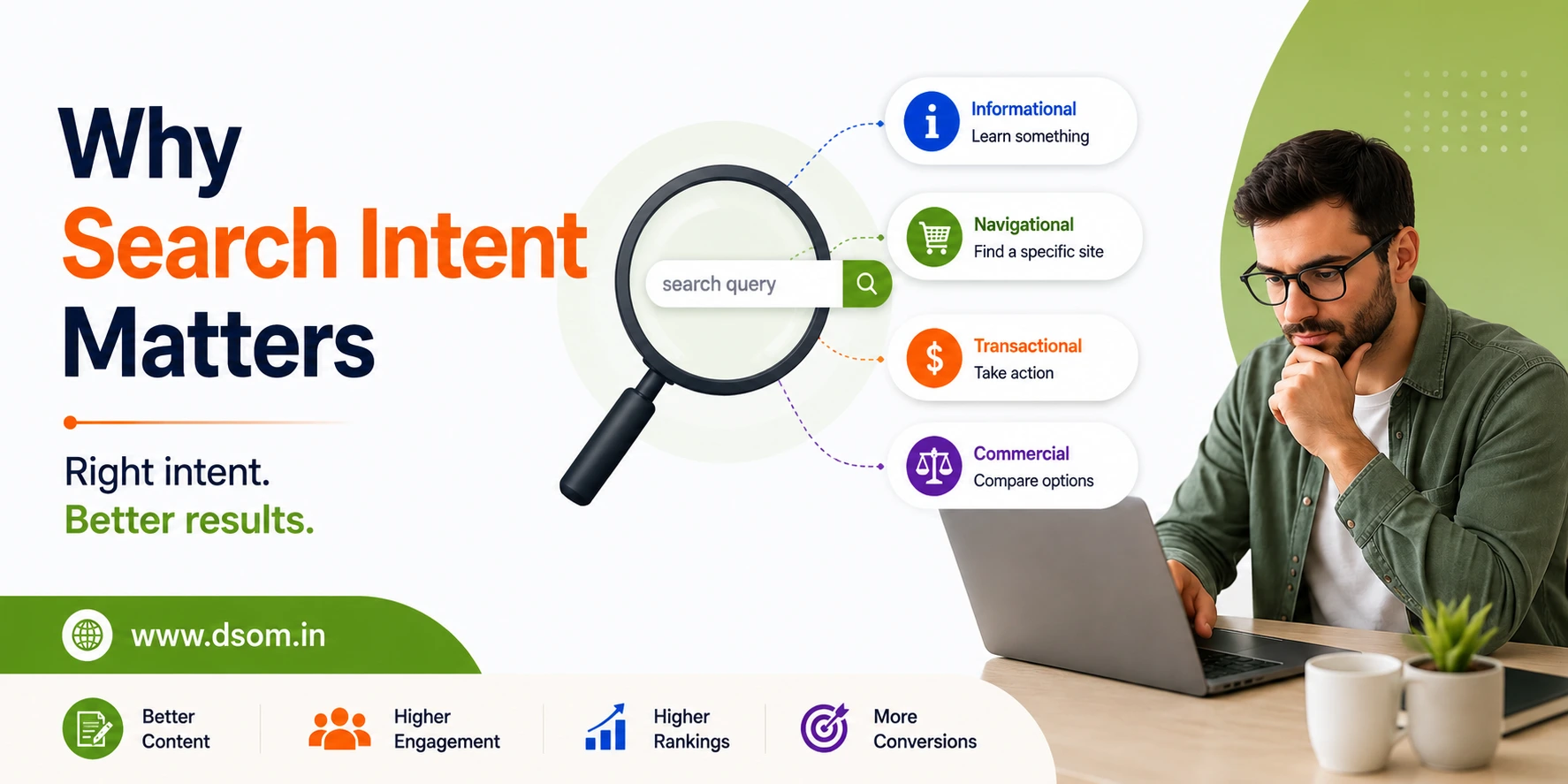
In 2026, relevance and usefulness, not exact-match phrases, are the deciding factors. Google’s Helpful Content System and ongoing algorithm improvements make intent even more important. A page stuffed with a target keyword but built to serve the wrong type of searcher will not hold rankings regardless of its technical quality or link profile.
There’s a second reason intent has become more critical: AI Overviews now appear for a large share of informational queries. Click-through rates on broad informational keywords have dropped sharply. A page ranking third today can receive a fraction of its previous traffic simply because the behavior of the results page changed, not the ranking itself.
Getting cited inside an AI-generated answer has become as valuable as ranking first for many queries. Content that clearly addresses the intent behind a query is far more likely to earn that citation.
The Four Main Types of Search Intent
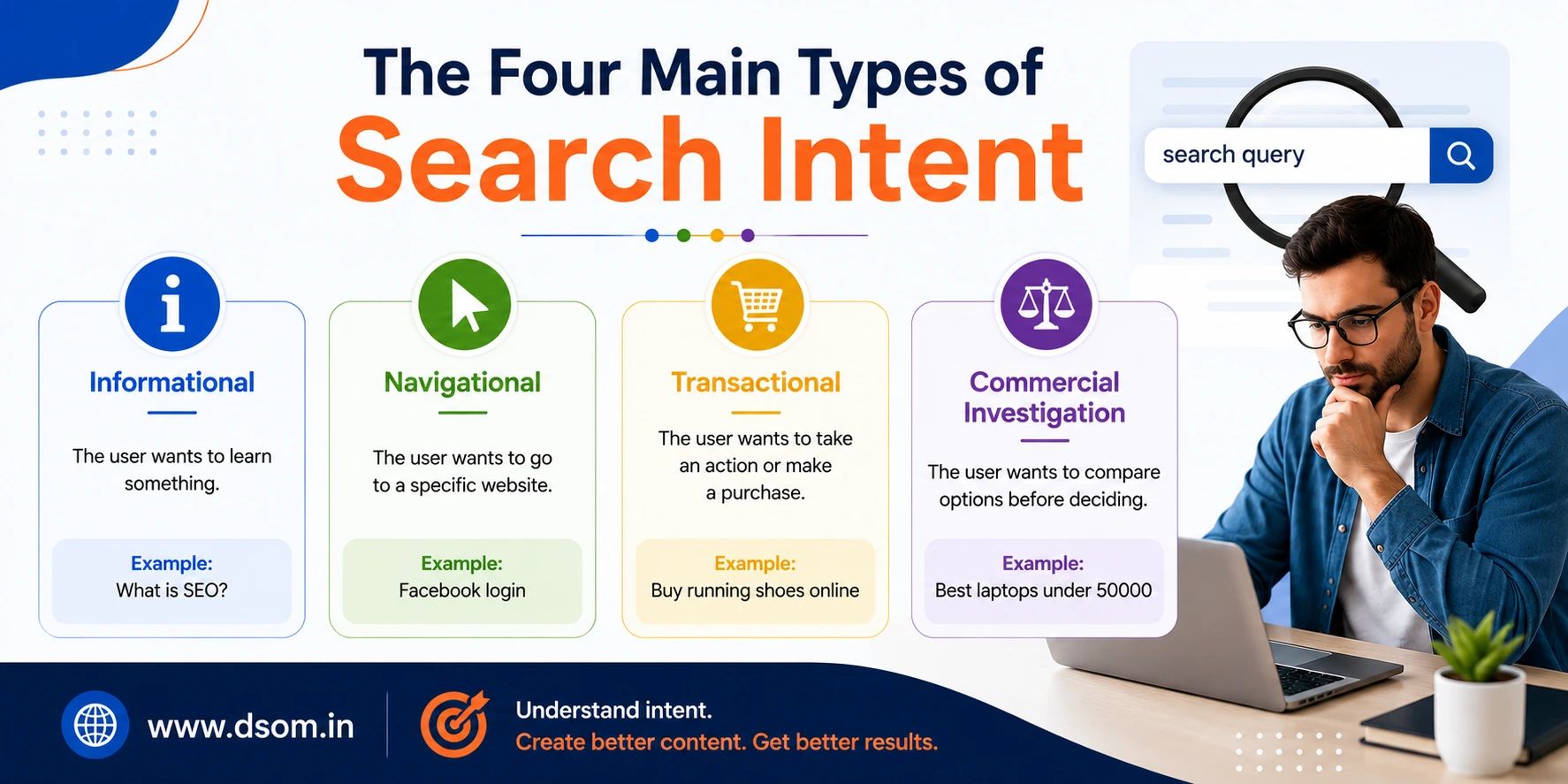
Most searches fall into one of four categories. Understanding these categories is the practical foundation of any intent-driven content strategy.
Informational Intent
This is the most common type of query purpose. The user wants to understand something, not buy anything. Queries like “what is search intent,” “how to improve page speed,” or “why does my email go to spam” all carry informational intent. Content for this type should prioritize clarity and depth. Trying to sell too early on an informational page almost always pushes readers away and signals to Google that the content doesn’t match what searchers expect. A well-structured guide, a clear explainer, or a thorough tutorial are the formats that consistently perform well here.
Navigational Intent
The user already knows where they want to go and is using a search engine to get there faster. Searching “Google Search Console login” or “Semrush pricing page” are classic examples. There’s limited room to compete here unless your brand is the destination. Optimizing for navigational intent means making sure your brand pages are correctly indexed, easily discoverable, and not buried under competitor comparison content.
Commercial Intent
This sits between informational and transactional. The user is close to a decision but still comparing options. Searches like “best CRM software for small businesses” or “Ahrefs vs Semrush comparison” are driven by commercial intent. Content here should help readers evaluate options rather than pushing for an immediate sale. Comparison tables, pros and cons lists, and honest reviews match this intent well. Crucially, the moment you push too hard for conversion on a page with commercial intent, you often lose the reader before they’ve decided you’re trustworthy.
Transactional Intent
The user is ready to act. Price isn’t usually the barrier at this stage; friction is. Searches including words like “buy,” “order,” “sign up,” or “get started” carry transactional intent. Product pages and landing pages should be optimized with clear calls to action, simple checkout flows, and minimal distractions. Ranking a long-form blog post for a transactional keyword is one of the most common, and most invisible, intent mismatches in SEO.
| Intent Type | What the User Wants | Common Search Signals | Best Content Format |
|---|---|---|---|
| Informational | To learn something or find an answer | “What is,” “how to,” “why,” “guide” | Blog posts, explainers, how-to guides |
| Navigational | To reach a specific website or brand | Brand name, product name, “login,” “pricing” | Homepage, brand pages, login portals |
| Commercial | To compare options before deciding | “Best,” “vs,” “review,” “top,” “2026” | Listicles, comparison pages, roundups |
| Transactional | To take action or buy right now | “Buy,” “order,” “get,” “download,” “sign up” | Product pages, landing pages |
How to Identify Search Intent Correctly
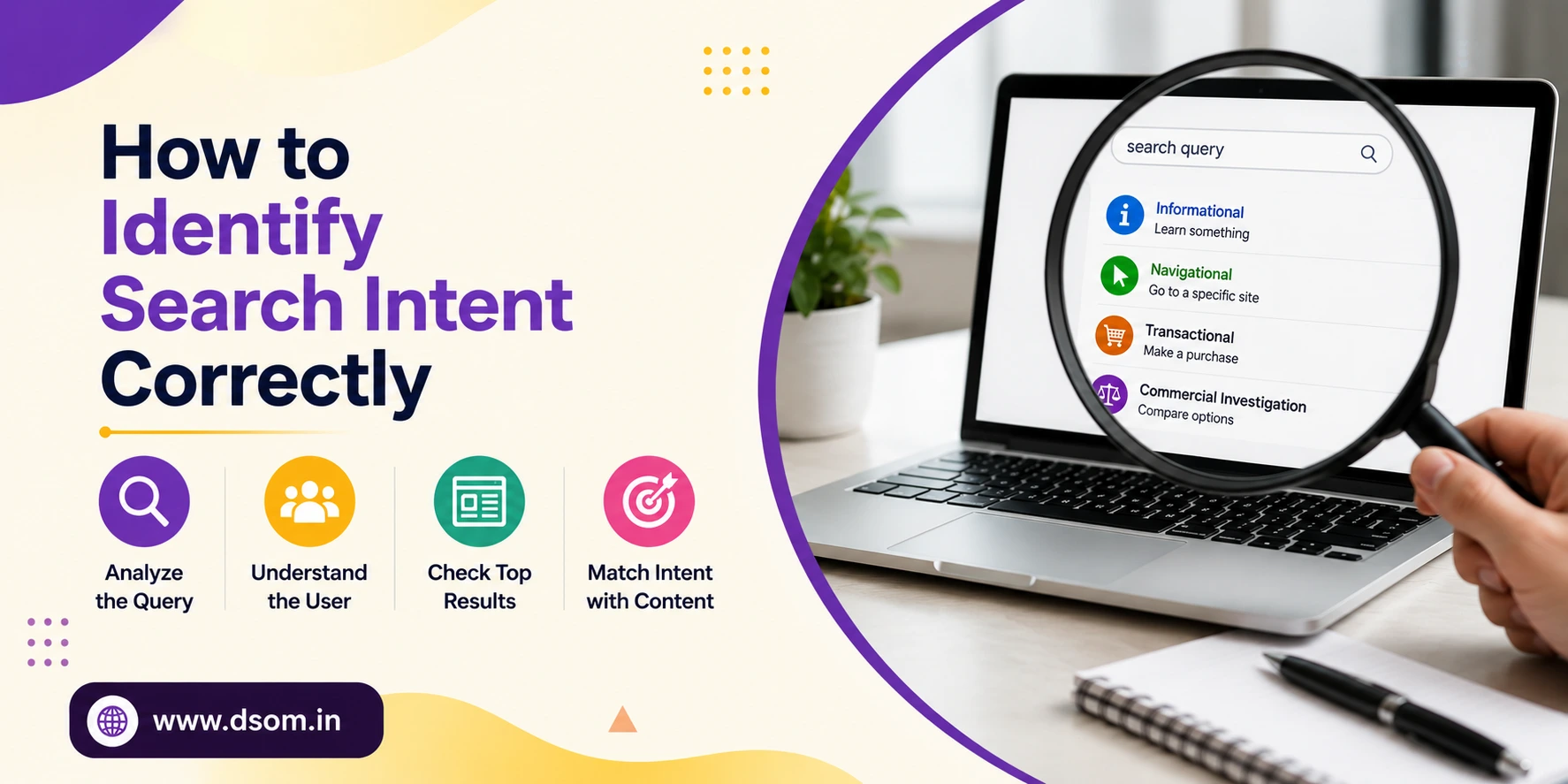
The most reliable way to understand what intent a keyword carries is to look at the actual search results, not to guess. Google has already done the interpretation work. The results page reflects what real users found satisfying for that query.
When analyzing a keyword, look at three signals in the top results:
- Content type — is Google showing blog posts, product pages, comparison lists, or something else?
- Content format — is the dominant format a how-to guide, a step-by-step tutorial, a review roundup, or a homepage?
- Content angle — what angle does the content take? “Best for beginners,” “updated for 2026,” “under $100”?
If every top result for a keyword is a how-to guide, and you publish a product page targeting that keyword, no amount of backlinks will overcome the mismatch. The SERP is telling you what Google believes users want, and aligning with that signal is the fastest path to ranking.
This approach takes a few extra minutes per keyword, but it replaces weeks of guesswork and is one of the most consistently valuable habits in any content workflow.
Intent Mismatch: Why Good Content Still Fails to Rank
Intent mismatch is one of the most common and least obvious reasons a technically sound page fails to perform. A service page targeting “how to fix a slow website” is a classic example. The keyword has clear informational intent. The service page has clear commercial intent. No matter how well-written the page is, it will not satisfy someone who wants to learn, and Google knows it.
| Common Mismatch | Why It Fails |
|---|---|
| Product page for “how to” keywords | Users want education, not a purchase prompt |
| Blog post for “buy now” keywords | Users want to transact, not keep reading |
| Homepage for branded competitor queries | Users want comparison, not a redirect |
| Sales page for “what is” queries | Users want answers, not a pitch |
If your page has a high bounce rate despite ranking, the first thing to check is whether your content type and format match what the SERP is showing for that keyword. Misalignment here is often the hidden culprit behind steady impressions and zero conversions.
How Search Intent Connects to the Buyer Journey
This concept doesn’t exist in isolation. It maps closely to where a user sits in the buying cycle, which makes it a powerful tool for planning content that serves people at every stage.
| Buyer Stage | Dominant Intent | Example Query | Goal of Content |
|---|---|---|---|
| Awareness | Informational | “What is content marketing” | Educate, build trust |
| Consideration | Commercial | “Best content marketing tools” | Help compare, guide decisions |
| Decision | Transactional | “Buy ContentStudio subscription” | Convert, remove friction |
| Retention | Navigational | “ContentStudio login” | Provide access, support loyalty |
Mapping your existing content against this framework often reveals obvious gaps. A business with strong transactional pages but no informational content is missing the top of the funnel entirely, which means it’s invisible to potential customers who haven’t decided to buy yet.
Common Mistakes When Optimizing for Search Intent
Even experienced content teams fall into predictable patterns that quietly undermine their results. The mistakes below are among the most common, and most of them are fixable once you know to look for them.
- Guessing intent based on keywords alone instead of checking actual SERP results. The search results page is Google’s interpretation of user intent, and it’s far more reliable than any assumption.
- Treating intent as fixed, when in reality it can shift or overlap. A query like “email marketing tools” carries both commercial and informational signals at the same time.
- Mixing too many intent types into one page without a clear primary direction. A page trying to educate, compare, and convert simultaneously often does none of those things well.
- Publishing content that matches the keyword but not the format users expect, such as writing a listicle when searchers consistently want a step-by-step tutorial.
- Never revisiting old content to check whether its intent alignment has changed. Search behavior evolves, and a page that matched intent well two years ago might now be serving the wrong type of visitor entirely.
Final Thoughts
Understanding search intent helps you create content that stays relevant beyond algorithm updates. Before publishing, ask who your audience is, what they expect to find, and whether your content answers their needs clearly. At DSOM (Dehradun School of Online Marketing), we believe that creating user-focused content is the foundation of successful SEO.
Businesses that align their content with search intent, match the SERP format, and solve real user problems earn better rankings, build trust, and drive more conversions. Focus on what people need—not just the keywords they use—to create content that delivers long-term results.